Kat Eye Studio

  • Home
  • Portfolio
  • Resources
    • Online
    • Books
    • Workshops
  • Blog
  • About
    • Artist Statement
    • Background & Experience
    • Contact

March 10, 2011 by Kat

Exploring with a Camera: Square Format

Composed

Happy Thursday! Welcome to Exploring with a Camera day, my favorite day of the week. Today we’re going to learn about composing with a Square Format. At the end of the post there is a link up, for you to share your images using a square format. If you want a chance for your Square Format image to be featured here on the blog next week, you can also place your photo in the Exploring with a Camera Flickr group.

I got the idea for playing around with Square Format from the book 150 Photographic Projects for Art Students by John Easterby. I haven’t used this format before, so I picked up another book that has become my “encyclopedia” for composition, The Photographer’s Eye by Michael Freeman, and looked at the traditional compositions for a square format. With a little bit of information in my head to guide my eye, I was off and exploring Square Format.

Let’s see what I learned…

Getting it Square

Unless your main camera is your cell phone, chances are you don’t have a square format camera. The typical frame format for digital SLR cameras is 3:2. This means that the length is longer than the height of the frame by one third. A standard size in this format is a 4×6 print. For point-and-shoot cameras the typical frame format is 4:3, where the length is longer than the height by only one quarter. It is closer to square but still not quite the same.

The first step of this exercise is getting a square format. You can always crop the photo into a square format in post-processing. This can teach you a lot, but it doesn’t help you to play around with composition at the time of taking the photo so you can make real-time corrections.

What the 150 Photographic Projects book suggests is creating a “pseudo” square format camera by blocking off part of the LCD screen so that you view only a square. Since I intensely dislike using the “live view” mode for composing with the LCD on my dSLR, I decided to modify my point-and-shoot camera (aka my “little camera”). This turned out great, because I was able to leave my little camera in this format for several weeks, even taking it on our vacation to Sicily, while not interfering with my normal photographic process using my primary dSLR camera.

To modify the LCD screen, I just taped a piece of computer paper over the LCD screen as shown below. I used computer paper because I wanted to have a similar color to the rest of the camera, to give a visually consistent border on the frame. Computer paper was not thick enough to block the light coming through the LCD, so I slipped a small piece of dark cardstock behind the taped computer paper and it worked beautifully.

I keep my camera set on center spot for focusing, so I just focus and recomposed as needed, like I do normally. With this minor modification, I was ready to go. My 9-year-old son, observing this little exercise, would occasionally take his camera and put a finger over the edge of the LCD as he composed saying, “Square Format!” In a pinch, that works too!

What follows are some of the compositions I explored. You’ll see a caption below each photo. “Cropped” means that the photo was created using the standard format frame for the camera and then a square format composition was explored using cropping in post-processing. “Composed” means that the photo was composed using my modified-LCD-screen as shown above. I still had to crop in post-processing to make the image a true square format, but the composition was decided in-camera.

Random


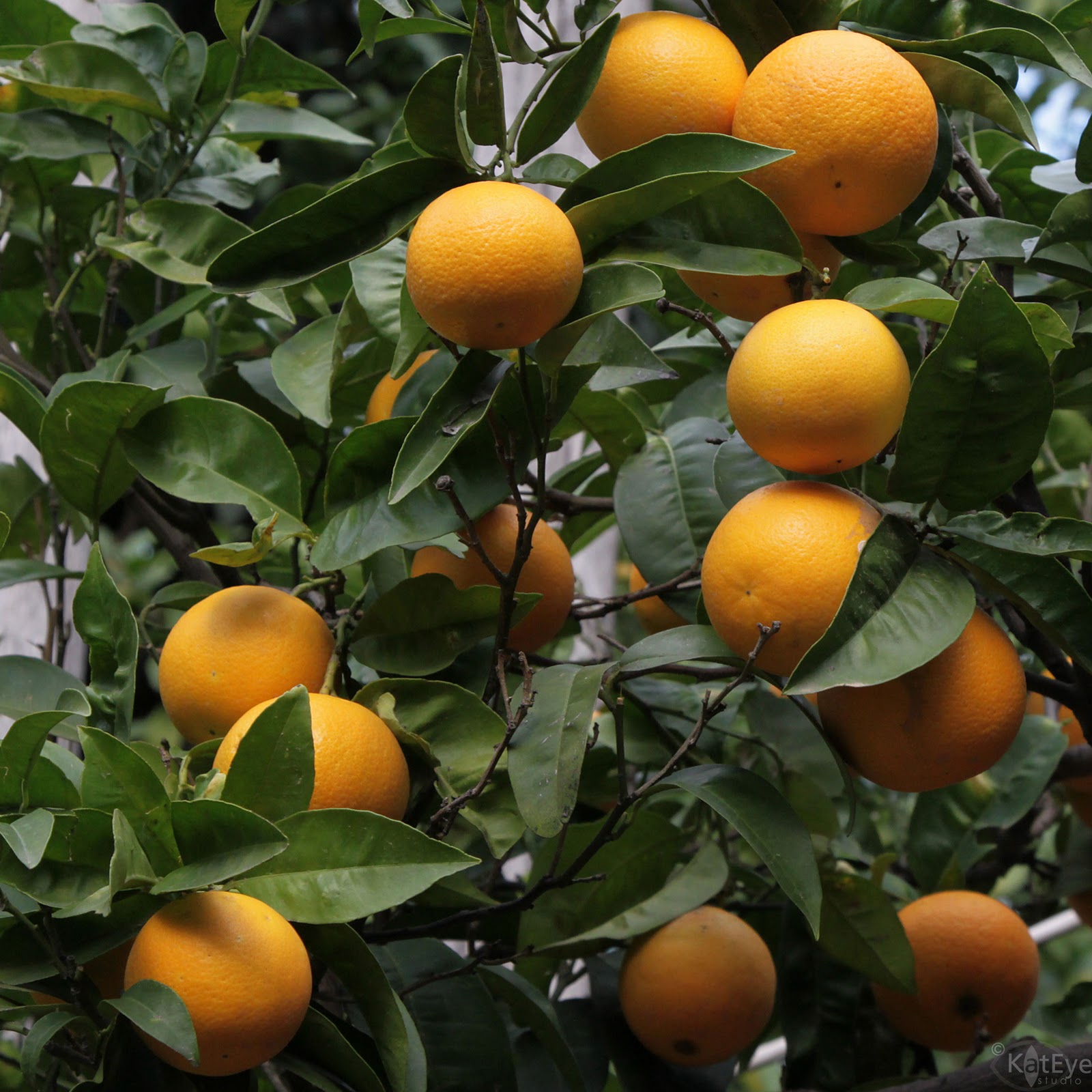
With the even sides, a square format is very static. This makes it a good candidate for “random” composition, where the eye takes in the whole at one time. This image of oranges on the tree from Sorrento was a good candidate for square format. There wasn’t a clear “focal point” with these oranges, it was more about the light,  shape and color of them on the tree.
Cropped

Another image I would consider to have random composition is this mountain scene from the Alps just north of where we live. There is no clear focal point in this image either, it is of the scene – sun, mountains, light, shadow – and square format works well. I actually needed to crop this one, since there was part of someone’s head on the right hand side. I was in line for the gondola down the mountain and couldn’t get a full frame image unobstructed. A square format crop allowed me to make this image something useful rather than throw it away.

Cropped

Concentric


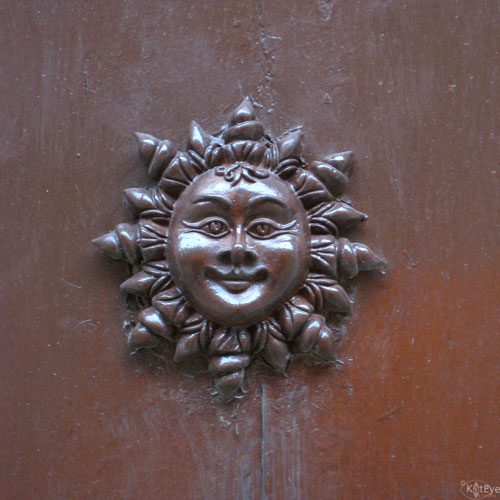
With it’s even sides, square format provides the unique opportunity to nest a circle in the square. Coming across a pretty door in Cefalù, Sicily, I captured one of the elements carved in wood using square format.

Composed

This door design from Erice, Sicily, captures another circle in the square. This falls into both the concentric and centered composition categories.
Composed

What other circles can you think of that would be great to capture in square format? Flowers, something like a Gerbera daisy, come to my mind.

Centered

With square format, you can get a good effect with centering your focal point, something that doesn’t work as well in rectangular formats.  This best capture of this window in Venice using square format was centered.

Composed

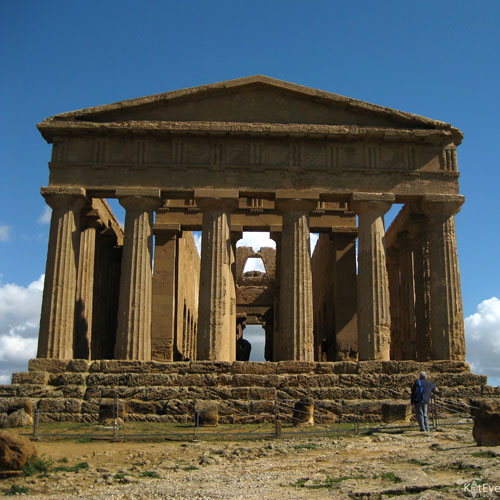
The ancient Greek Temple of Concord, found in the Valley of the Temples in Sicily, is front and center in this image. It’s all about the temple here!
Composed

With square format, you can also put the horizon on the center line with good effect, unlike a rectangular format. I saw some great examples of this by American photographer Harry Callahan when I visited an exhibit of his work in Paris. Here is one of his images as an example.
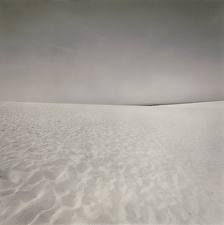
Photo by Harry Callahan

Diagonal


Just like in rectangular format, diagonal lines can be very interesting compositions. The image below of Murano glass displayed in Venice is an example of both diagonal and centered composition. The thing I noticed when playing around with cropping diagonal images is that you need a different angle on the diagonal line to work in square format. If an image was composed with a diagonal line for a rectangular format, there is a good chance it is at a wrong angle to just crop into square format. In the case of this image, I had played around with different angles and happened to have one that worked for square format.

Cropped

Off-Centered


With more rectangular subjects, I found that the subject needed to be off-center using square format. A centered image works with a square or circular subject, but not so well for a person or a tree. Cropping this self-portrait of me in Venice solved the problem of too much wall on either side. Normally, I would have taken this in a vertical orientation, but you can’t really do that when you set your camera on a step. Square format solved my composition problem.

Cropped

The tree-in-the-field image below from Parco di Monza is influenced by the Rule of Thirds. It works with square format too!

Composed

Balance


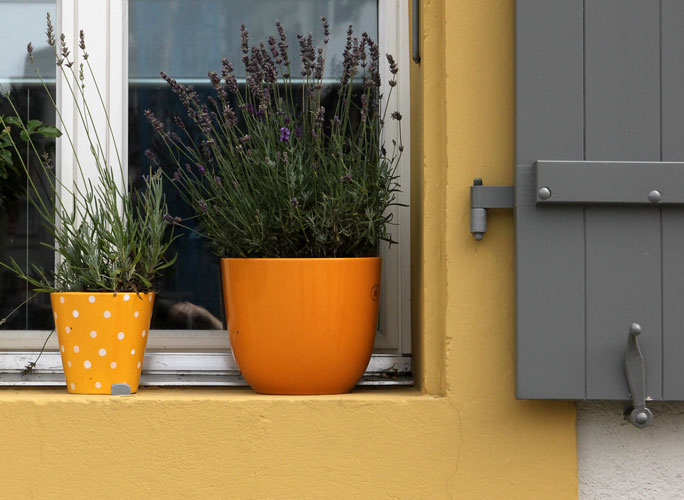
Ultimately, what it all comes down to in any composition, regardless of format, is balance. The elements have to be balanced within the frame for a pleasing image. The lead-in image, another scene from the town of Cefalù, Sicily, is a good example of a square format image that doesn’t follow any of the specific compositions described above, but balances the elements of color and shape into an interesting photo.

This balcony with the interesting ceramic pots in Taormina, Sicily was another square format image where the composition was derived by balancing the elements of color and line.

Composed

So, how about you, do you have any experience with square format? If not, I encourage you to explore along with me here. Go through your archive and see if there are any images where a square format crop would work well. Modify your camera for a few days to create a “square format” and see what you find. Come back here to link in and share your findings with the rest of us. It will be interesting to see all of the takes on square format that you link in for this theme!

Filed Under: Exploring with a Camera, The Kat Eye View of the World Tagged With: balcony, Cefalu, door, Erice, glass, Italy, ruins, Sicily, Sorrento, square, square format, Taormina, tree, Venice, window

February 21, 2011 by Kat

Choosing your Context

Meet Stevie, my cat. You don’t see him much on my blog because he’s hard to photograph. He’s either sleeping buried under a pile of blankets or moving non-stop following us around. If I see Stevie in an interesting spot or in good light and leave the room to get my camera, it is likely he follows me as I leave the room. Occasionally I get a good photo of him, like this one yesterday when I already had my camera in hand for other reasons. I got two shots, and then he was gone.

Yesterday I talked about context, and how photographers, or any artists really, choose the context they share in their art. Nothing is a reproduction of reality, it is always influenced by the artists point of view and what they wish to convey.

This photo is no exception. I could have focused in tighter on Stevie, but I wanted the context available around him. It is not just a portrait of Stevie, it is also a portrait of Stevie in our apartment in Italy. The green pot shows one of the colors of our kitchen, the radiator shows how we get our heat. The windows are typical Italian – simple glass and wood frame, with the turn handle to open. There are no screens on the window but you can see the wood bar, which we’ve guessed is to prevent small children or things on the window sill from spilling out the window when it is opened. Stevie sits on the window sill, made of marble. All of these things tell more of the story, not only “who” but “where” Stevie is.

I find it interesting to think about this concept of context. Some of the context in my photographs comes from split second decision making, some of it comes later with cropping and post-processing. How, and when, do you decide the context in your art?

Filed Under: The Kat Eye View of the World Tagged With: cat, home, Italy, pot, window

February 8, 2011 by Kat

Waiting

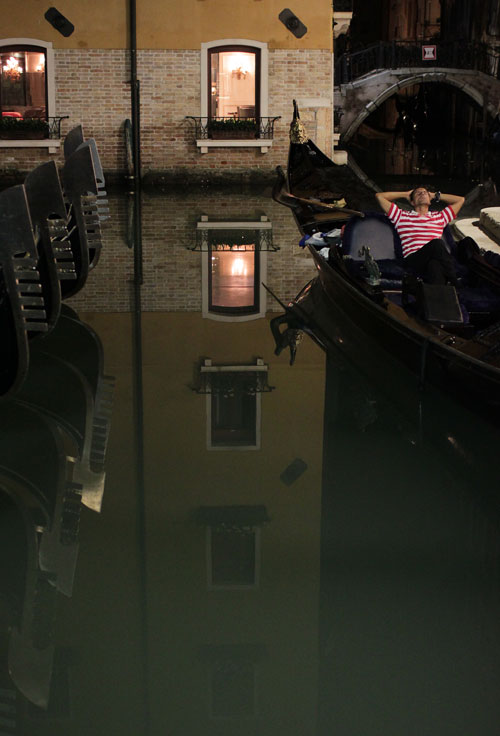
The night is so quiet and still, you almost have to hold your breath for fear of making a ripple in the water and ruining the scene. The lone gondolier on duty rests silently in his craft. He has nothing to do, other than wait for customers to appear for a midnight gondola ride. His daydreams and night dreams drift off into infinity like the reflections in the water. Just waiting. Someone will come.

Guess what? The creative space I was feeling yesterday was perfect. A friend asked me for some design help, and I happen to have this creative time free. I love how things work out. Now I have a fun new project, something completely different to do for a little while. I can help her out before getting back to my own ideas, and will be refreshed for the change of activity.

I was just waiting, like the gondolier, and the right thing appeared…

Do you find yourself waiting? Do you take the time to pause and breathe, and see what comes along?

Filed Under: The Kat Eye View of the World Tagged With: gondola, Italy, night, reflection, Venice, water, window

February 5, 2011 by Kat

London Photowalk: The Report

Have you ever met an online friend in person? If you haven’t, I encourage you to try it. You might be a little nervous about how it is going to work out, but you will likely discover that your online friendship and interests translate into real life meetings naturally. That’s been my experience anyway, and I’ve now met quite a few of my online friends in person as we travel around Europe.

The London photowalk was a great way to meet a few photography friends at once. Justine, Laura and Christine joined Kirstin and I for a few hours of walking and talking last Sunday. I’m thinking we should call them phototalks, because we talked about photos more than we took photos. It was chilly so we popped into a cafe for some hot chocolate for a while, and later finished up with lunch.

A few hours with some fellow friends who love photography was heaven. We talked about cameras and classes and what we love to shoot. We talked about our families and kids and jobs and current events. They already started talking about where to go for future photowalks, and I’m sad I won’t be there!

Below are a few of my favorite images from the photowalk. I’m happy to have these images, but I’m even happier that I now have a real world connection with more of these wonderful women photographers. Justine, Laura, Christine, Kirstin – thank you all for coming! Links to their photos can be found below.

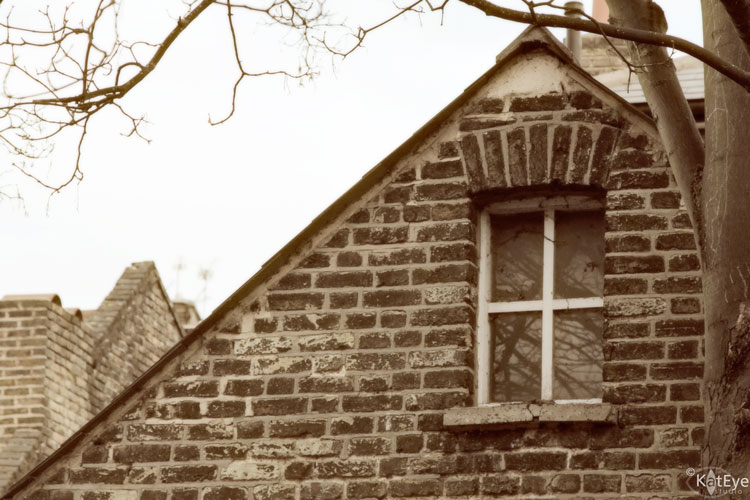
We met at the Greenwich train station and started through some of the old brick houses. I wonder what’s up in this attic?

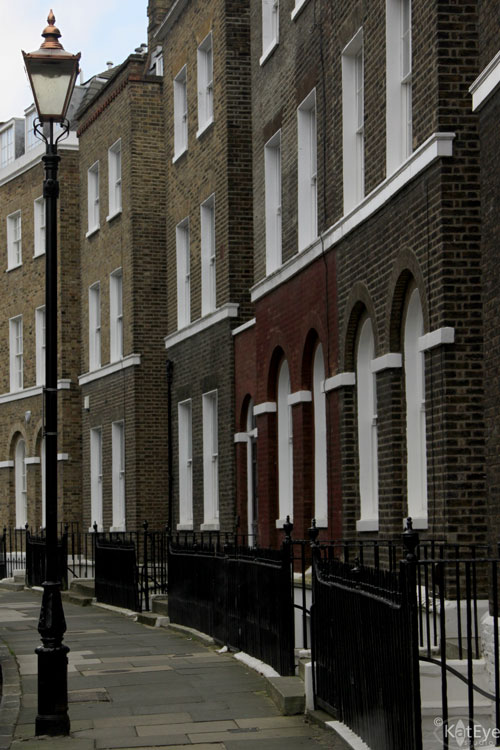
The Greenwich Circus is beautiful, I love all of the shades of brown.

Along the way we found some nice color, and texture. Justine had fun peeking in to see what was behind this broken window.

Christine must have been attracted to the brick buildings too, stop by her blog post here to see her photos.

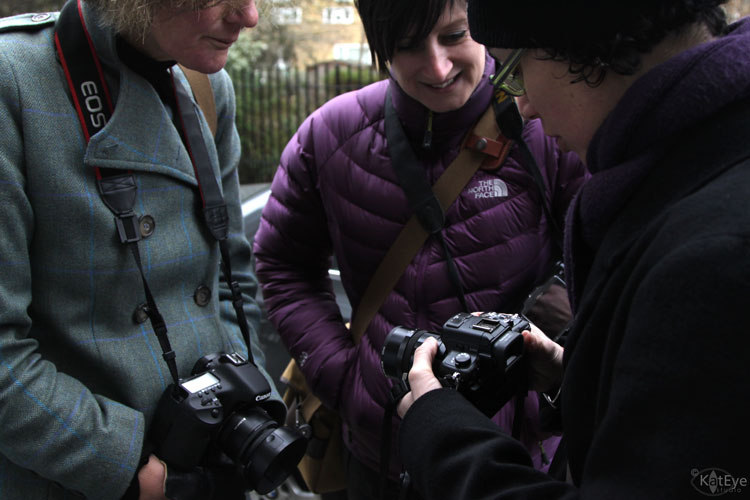
We stopped to talk equipment now and then, it was fun to see what everyone had. We had quite a variety among the five of us. Below Justine and Laura admire Kirstin’s tiny Lumix.  Kirstin has another photo of us talking cameras on Flickr here (scroll down to the comments below her photo).

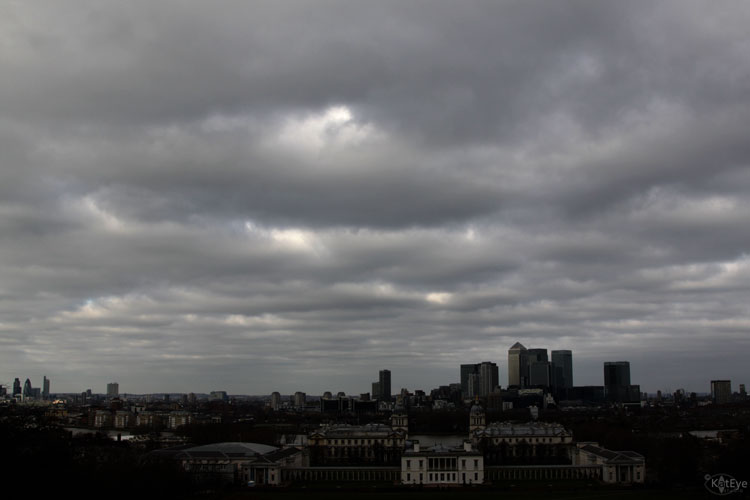
We climbed to the top of the hill in the park (not sure which one it was!) to the Royal Observatory. I enjoyed the mpressive views of the city and another wonderful English sky.

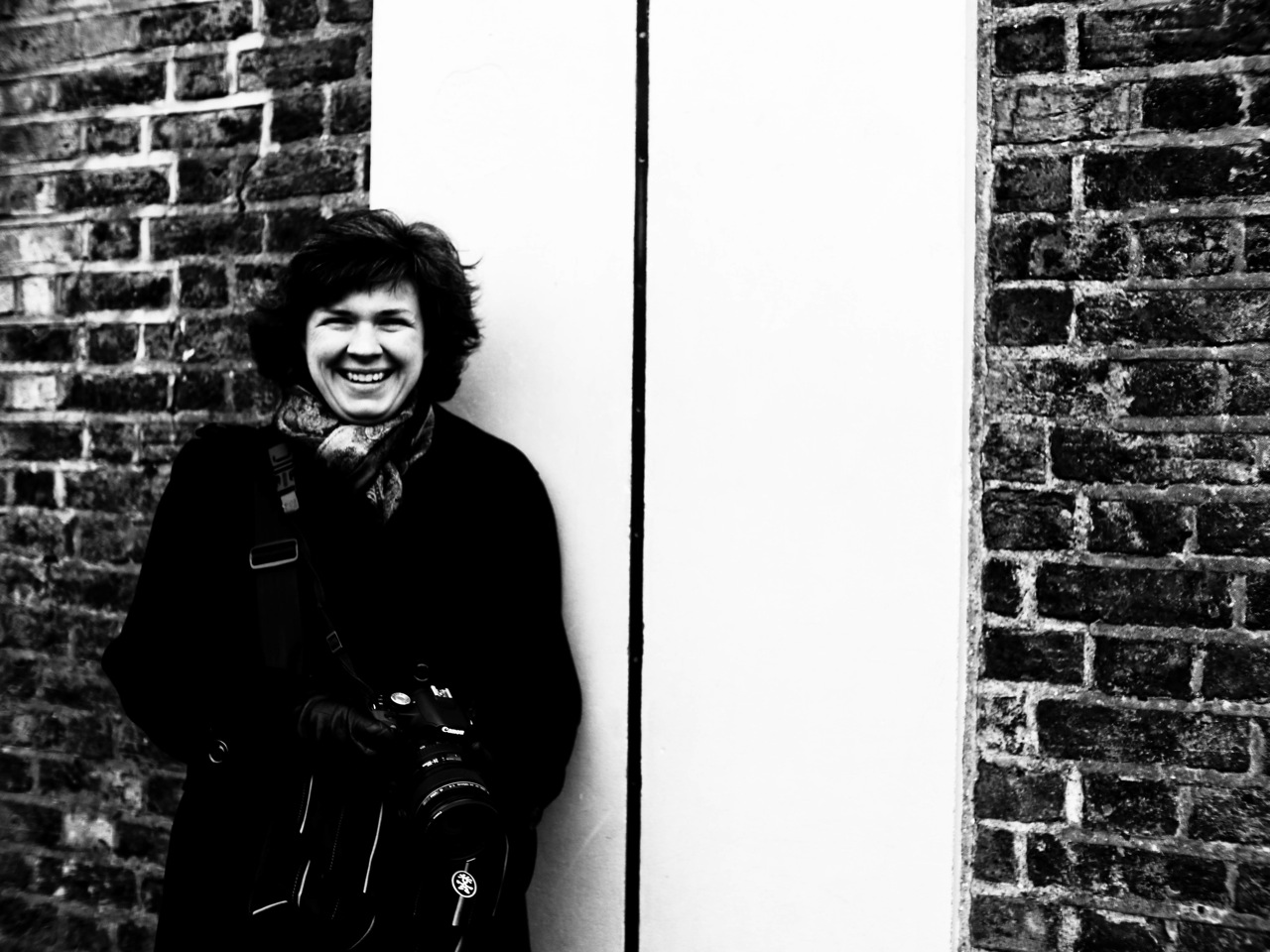
But the best part of the Royal Observatory was visiting the Meridian line. Greenwich Mean Time ring a bell for anyone? Thanks to Kirstin for capturing the moment for me.

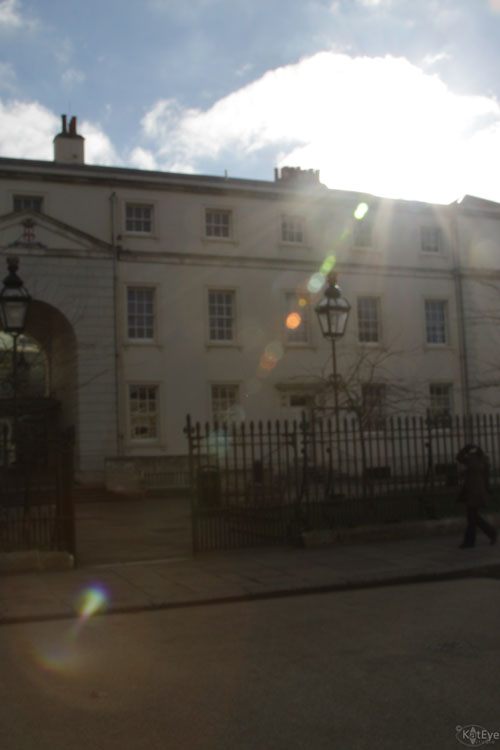
One of the things I wanted to learn from Kirstin was flare – she’s a master! Thankfully the sun decided to appear for a few brief moments for some instruction. I think I figured out my big problem – I need to learn to use the Live View mode on my camera because I need to shoot into the sun. Below is an image straight out of my camera using live view, I didn’t even know how to focus in this mode at the moment I took it. I kind of like the tilty-out-of-focus-odd-composition though, as a memory if nothing else.

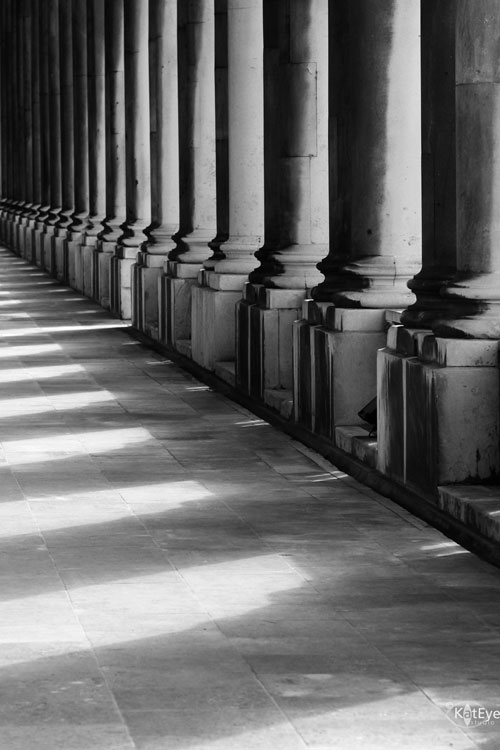
We ended up at the naval college, which is where many movies are filmed since it still looks like the 19th century with no stoplights, etc. Gulliver’s Travels and The King’s Speech are two recent films that had scenes shot here. My favorite part was this collonade. I loved how the light was streaming through, and the light/dark contrast of the columns. Laura has another image of this same location on her blog here, Justine’s is here, and Kirstin took one of all of us shooting this area that is really fun (linked above).

We stopped for lunch after this and then went our separate ways, although we’ll stay connected online. Another great day, bringing my online connections into the real world.

So, where shall I go photowalking next?

Filed Under: The Kat Eye View of the World Tagged With: black and white, brick, England, Greenwich, London, photowalk, window

January 24, 2011 by Kat

Castle Views

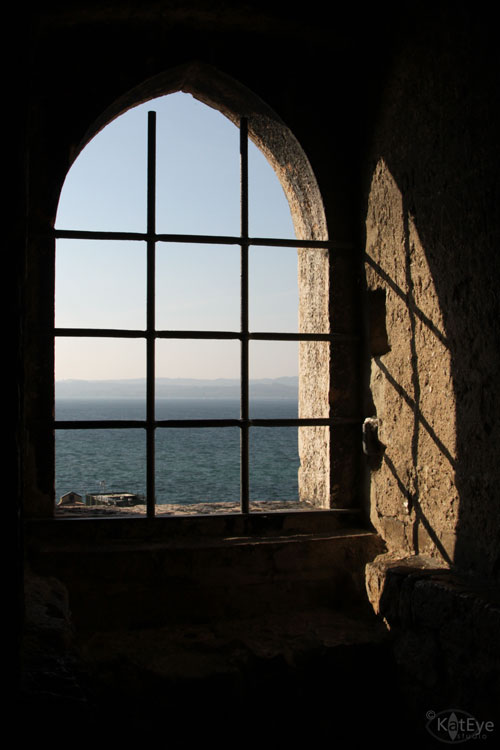
A craggy castle on the tip of a peninsula, guarding against intruders to a land of days gone by. This castle is in Sirmione on Lake Garda, an hour and a half drive from our home here in Northern Italy. Yesterday afternoon we took a little day trip out to this town, exploring a new part of this beautiful country. Besides this wonderful castle, there is a nice pedestrian town with wonderful lake views, natural hot springs, roman ruins and the most frigid wind coming off of the lake. A perfect afternoon for some of the best gelato I’ve had in a while!

I love these old castles. They are so solid, so real, even today. You can tell that life was not easy in the days these castles were needed. Bare stone rooms, small spaces, dangerous stairways. The majority of the inhabitants worked long hours in difficult conditions, lived in cramped spaces without much reward other than food, shelter and protection from invading forces.

This vision is so different than our idealized version of castles with turrets and princesses with flowing dresses. I find I like the reality of these solid places better than the gilded rooms of kings and queens later in history. There is something honest and true that resonates in the bare stone, coming through the centuries to speak to me in this age. Do you feel it too?

Filed Under: The Kat Eye View of the World Tagged With: castle, Italy, lake, Lake Garda, Sirmione, stone, window

January 4, 2011 by Kat

Lessons from Abroad: Find a Regular Practice

Lessons from Abroad: Find a Regular Practice

[Today’s post is the second part of a five part series. The first article was published here.]

In the last post I talked about how changing up your schedule can help free up your creative energy to find your purpose and passion. Today I’m going to explore the next key element I’ve learned during my time in Italy: Find a Regular Practice.

In many personal development books I’ve read, the idea of a “daily practice” is somehow incorporated. One of the first ones I encountered was in Julia Cameron’s The Artist’s Way, where the “morning pages” are a crucial part of her process. Over time I’ve noticed almost every personal growth or spiritual philosophy incorporates and encourages some form of contemplative activity on a regular basis.

I have started and stopped different daily practices depending on the books I’m reading or the programs I’m following. Over time though, with trial and error, I have settled in to three main things that work for me as part of a regular practice: Inspirational reading, journaling and walking. These three items are complementary and work together for me to keep me balanced and centered, as well as open and ready to receive ideas. They help keep me in touch with my intuition and those messages from my authentic self.

I don’t have a regimented schedule with my practice. In fact, that’s why I say “regular practice” and not “daily practice” in the title. Here’s what my practice looks like:

Most mornings of the week I will get up and get my cup of tea (I guess we can add “tea” in as part of the practice), and then sit down to read something that I’m interested in. This is not fiction reading – it could be essays, part of a book on creativity, something on personal development. I have a number of books in progress sitting next to me, and I’ll pick up whichever one strikes me. I read a few pages and then I journal for a little while. Sometimes the journaling is on what I’ve read, sometimes it is on a problem that is on my mind, sometimes it’s just random ideas I want to capture. Once I start to write, I write until I feel done. That could be one paragraph or several pages, depending on what’s coming. Later in the morning (that morning creative time I talked about before!) I will often go for a walk or jog, with no music to distract me, in the park near my home.

I don’t do all of these every day – in fact most mornings I do 1 or 2 of the 3 – but over time I engage regularly in all of these activities.

This group of practices combine in an amazing way for me. It’s as if I get creative fuel, raw ideas, from the reading. The journaling helps me clear out the blockages in my brain and my emotions from daily life, which creates the space in myself for new ideas to be generated. With that open space and creative fuel available, the walk becomes where I receive the resulting messages and ideas. Sometimes the reading sparks an idea that I subsequently write about in my journal, which leads to making a connection or discovery about myself. Sometimes something I’ve written about in my journal or something I’ve read will sit in my mind and I’ll mull it over, and it comes out as some new idea during a walk – possibly days later. It is amazing how many creative ideas, how many realizations that have led me to my passion and purpose, have come to me during these walks. I now keep a small notebook with me at all times, just to capture the ideas.

I also find, in the process of all of this amazing idea generation and self discovery, I gain perspective on my life in general. I’m able to let go of the damaging focus on stressful situations. I am able to disconnect from the things that previously would wrap me up – preventing sleep, contributing to bad moods, generally coloring my life negatively. I can see problems with a new view.

There is nothing new in the ideas of a regular practice, or the activities that comprise my practice. As mentioned above, many personal or spiritual development programs have incorporated these elements, time and time again. They all have a plan – if you do it this way, on this frequency, you will reap these rewards. While that is probably true for the creator or author of the program, I think part of this key is that each of us has to find what works for us. If we follow a regimented plan that doesn’t really connect with us, even if we see some initial benefit we won’t sustain it long term.

One of the most important elements of defining a practice is occasionally losing the practice – falling off the wagon, stopping it, letting it dribble away. It may seem counter-intuitive, but these are actually very important occasions for really integrating and owning your own practice. It’s through the losing of it, and seeing the results of losing it in our selves – how we feel, how we interact, how it affects our lives – that we become truly committed. For me, it’s taken time – starting and stopping and restarting again – to finally come to the point that I learn to choose the practice over the other things that compete for my time.

That’s not to say that I don’t skip it sometimes for an extended period. Vacations, business trips, certain busy times come along for a week or two. But during these times I know they are coming, consciously prepare myself and make the choice to skip it, and then make the choice to come back to it when that brief time is over. I’ve found that for me, a week or so of skipping isn’t damaging. I can remain centered and grounded and can come back to it. Beyond two weeks, however, and I start to lose some essential pieces of myself, my connection to my core. I now recognize this change and am not willing to lose my practice anymore. It’s a wonderful feeling – to make the choice based on what’s best for me.

Here are my ideas about how you can apply this key concept of “Find a Regular Practice” to your life too:

  • Start experimenting with some different practices. These could be similar to mine, or they could be other practices like running, yoga, meditating, creating art, etc. You might already have something that you’ve started and stopped over time.
  • When you find one that makes you feel good – when you are done you feel refreshed, revived, centered, clear – stick with that one for a while. Note how you feel when you do it, and when you don’t do it. Experiment with different times of the day, tap into the peak of your energy cycle as discussed in Change up Your Schedule for maximum impact.
  • Start with one practice at a time, don’t go overboard trying to start two or three new things. You will probably give them all up if you do that! My practice has evolved over time to these three, but I didn’t start out with all three. I started with the journaling, eventually added the reading and latest the walking. I’ve done them all off and on but have recognized over time how they work together.
  • Don’t follow someone else’s regimented schedule. Maybe start out with suggestions, but experiment, shift, tailor your practice to yourself. We all have different needs, consider any defined practices a starting place. It’s like a buffet, you get to pick and choose what you want to incorporate into your life. There will be people who swear by their schedule, their program – because it works for them. Remember you have to find what works for you.
  • When you have let the practice go, and realize that you have let extraordinary circumstances or even everyday life run you over, be kind to yourself. Notice how you feel without it, contrast that with how you felt when you were regularly practicing. Decide if the practice is something you want in your life or not, if it’s worth it to you to make the changes to incorporate the practice as a regular part of your schedule. It’s a choice, it’s up to you. Don’t judge yourself or place unnecessary rules on yourself, be honest and true to the answers you find within.

When you do these things, when you find a regular practice that truly works for you, I can guarantee you won’t want to let it go. The connection that you gain to your true self, your center, becomes vital. The clarity that you will find, the ability to be open and listen to what your authentic self has to say, will help you to discover your passion and purpose better than any other prescribed method around.

(Photo is from Murten, Switzerland)

Filed Under: The Kat Eye View of the World Tagged With: flowers, Lessons from Abroad, Murten, pot, Switzerland, window

« Previous Page
Next Page »

search

Archives

© Copyright 2017 Kat Eye Studio LLC