Kat Eye Studio

  • Home
  • Portfolio
  • Resources
    • Online
    • Books
    • Workshops
  • Blog
  • About
    • Artist Statement
    • Background & Experience
    • Contact

May 23, 2011 by Kat

It Happened Among the Roses

Yesterday I found myself in a rose garden, a completely unplanned event. I had walked down to a local art exhibit of young artists, to get a little bit of creative inspiration. As I was in the gallery I looked out the window and there was a rose garden, in full bloom. It was gorgeous. I was kicking myself, I hadn’t brought my good camera! It was a hot and humid day and since I was walking, I wanted to travel light so I left my SLR at home. Strike one against me.

I did have my little point-and-shoot camera with me, which always does well in a pinch. I explored the rose garden, looking to find interesting compositions, color and light. Since I have Finding Form on my mind as the current Exploring with a Camera prompt, I noticed that roses are an amazing subject for the study of form. So much light and dark, along with intricate curving shapes, within a rose. I was happily exploring away when the “low battery” light started blinking and the camera eventually died. Strike two against me.

Finally, at a loss for photographic equipment, I pulled out a little sketch book and a mechanical pencil. I had dropped this in my bag at the last moment, thinking of my recent painting class and the instructor Flora’s encouragement to sketch nature. These roses were too beautiful, I felt the urge to continue to study them, and pencil and paper were all I had left.

Look what emerged on my page…

Now, I was wholly and completely stunned. I was just focusing on shapes and light and dark and look what happened? I tried another one…
Um. Yeah. Can I just tell you, I had no idea that I had these in me? I’m trying to figure out where these came from. I used to draw, back when I was a kid, but of course all art stopped when I went  for the “college prep” classes in high school and then studied engineering in college. I’ve done a little bit of drawing here and there, the last couple of years, but never had it click like it did yesterday. 
I’ve discovered a new love. Photography, painting, and now I’m going to have to explore drawing more too. The feel of a pencil on the paper, the drawing of shapes and shadow, was amazing. What would happen if I actually practiced? I’m going to have to find out.
It turns out, I’m glad that I didn’t bring my good camera. I would have never spent the time with pencil and paper if I had that camera, my first love, with me. You don’t often hear stories of where being unprepared pays off, but in this case it did!
(Linking in to Creative Every Day and The Creative Exchange today. Hello to all!)

Filed Under: The Kat Eye View of the World Tagged With: drawing, flowers, Italy, Parco di Monza, rose

May 21, 2011 by Kat

All Locked Up + Swap Update

I am in love with locks lately. I seem to have quite a few from our visit to Greece a few weeks ago. But, seriously, who could resist this color and shape? And those little embossed dots? The square bolts? Could you have resisted?

I’m considering this as one of the images in my next postcard order. We are so, so close to my goal — 195 people are currently signed up for the Liberate Your Art postcard swap! Isn’t that awesome? If we hit my goal 200, I promised that everyone signed up with get a postcard from me in addition to 5 postcards they will receive from other participants. I’m so excited to be this close to the goal, and it’s time for me to think about my postcards too! Especially since I liberated most of my current stock at the Do What You Love retreat last week. Postcards were a great way to give people something a little bit “more” of my art than a business card. Everyone seemed to really like looking through them and choosing their favorite too.

There is still time to help me get the word out or to sign up for the swap yourself! I’m going to close sign up on Saturday, 4 June, so that I can be sure that everyone gets the final details I send to the list in June. Go here for the rest of the details, to get a button for your blog or to sign up.

I’ve added tons of new links to the participant link list this week. That means it’s time to go visiting again. Can you find the artist who paints on rocks? How about an artist who lives in Australia? They are in there, and so, so many more amazing artists. Pick two or three links, go and visit, and leave a note letting them know you stopped by from the postcard swap!

Here are the new links added this week:

Nomadic Notebook
Well of Creations
CindyLew’s Studio
Om2Art
Hysong Designs
The Weekend Photo Warrior
Tina’s Tree
The Studio 56
Kristen Walker
naperie
Rosie Grey
This Life through the Lens
Not Everyone Has Film
Sloane Solanto: A Colorful Life
Ravenous Rae
sassyangelac
My Midlife Creativities
MakieDoll
Tracy Swartz, Whimsical Gourd Art
One Thousand Paintings
One Little Promise
Amber Leigh Jacobs
Marie Z. Johanson
The Queen of Creativity
Expressive World
Random Thoughts Do or “Di”
Lyrical Journey
Karen Koch, Life Needs Art
My Sweet Prairie
dye~ing to be yours
Knottyneedle
my heart art
ODDImagination
Crafty Creativity
Jenna Kannas Inspirations
Going a Little Coastal
Starry Blue Sky
Quilting, Calle and other things
Matthew and Larissa
sightspecific
Studio Mailbox
Artimagica
Poetic Mapping
Simple Mansion
By Jen
Paper Bird
Musings of a Hennaphile
She Dreams of the Sea
The Little Things…
Tangerine Meg
amaze, surprise & delight
love PEAS
Straightlinez
Kristen Laudick Photography

And of course all of the ones from before:
How to Feather an Empty Nest
Learning as I Go
Paloma Chaffinch
Fiberworks
Ashley Sisk’s Ramblings and Photos
Jenny Shih
Life @ RuffHaven
kharliebug
Here and Now
Living in a Still Life
Bastelmania
Donna Did It
Left in Front of Right
The Red Tin
Altered Muse Art
Dreams and Whispers
Maddy’s Stitching Corner
Simply Life Photographs
Pointy Pix
Natasha May
The Vintage Artist
Digital Experiments by Carolyn
WJC’s Digital Designs
Creating my Life
icandy
i wanna be me when i grow up
Giddy-Up Let’s Ride
The Creative Identity
Elizabeth GLZ
Jofabi Photo
A New Day, A Different Way
A Rural Journal
Alchemy of Art
eyechai
Picturing the Year
Superdewa
Hounds in Heaven
BleuOiseau Photography
Aquarel Rivers
The Wright Stuff
The Mrs.
Urban Muser
deustchemexicana
{Furi Kuri}Travels
A Little Blue Sky
carola bARTz
Same Day: Thirty Years Apart
Camper
Cottage 960

Filed Under: The Kat Eye View of the World Tagged With: color, door, Greece, liberate your art, lock, pink, postcard, Santorini, swap

May 20, 2011 by Kat

A Whole New World

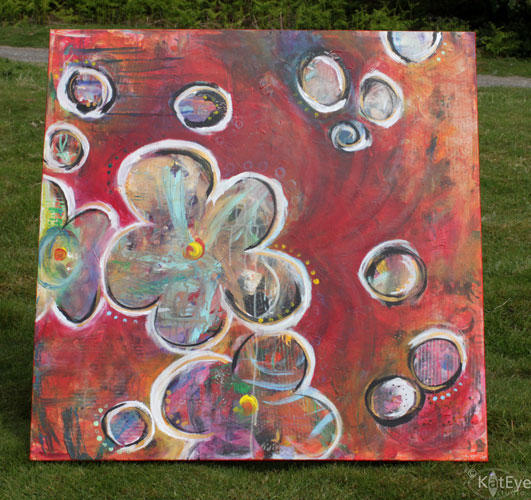
Blooming Collaboratively, 30x30in, Acrylic on Canvas

Have you ever craved something, but didn’t know how to start? That’s painting for me. I’ve had the desire for two years now, to paint big, bold, bright paintings. Paintings that expressed something more than the reality around me. Something that would come from intuition and a place deep inside. I’ve dabbled in painting but on a small scale, and without getting to where I wanted to go.

I finally found a way to tap into that inner creative energy that’s been wanting to run free in Flora Bowley‘s Bloom True painting class last week at the Do What You Love retreat. A couple of days ago, I shared the process we learned over the three days to get to one finished painting. Today I’m sharing images of the three paintings I worked on in the class, in celebration of Paint Party Friday.

Painting #1 (above) I’ve titled “Blooming Collaboratively” because it is not wholly mine. Flora teaches a lot about non-attachment and using what “is.” She helped us work through our attachment issues by having us paint on each other’s canvases at the beginning of the first day. An even bigger lesson came mid-morning the second day, when we had to give one of the two paintings we were working on to the person on our left. Yep, a day and a half of painting on this canvas, and now it’s not ours. Big, big lesson in non-attachment.

This painting is partly done by Carissa, who was painting to my left. In the painting I received, I noticed the three bright orange and yellow dots. I had just been sketching flowers on the trees as part of our morning exercise, so the flowers just came, along with the circles. All of the painting you see in the middle of the flowers and circles is the original painting I received. I went from there with the background and details.

It’s interesting, I really like how this painting turned out, but I’m not attached to it. I don’t feel like I can really call it “mine.” It came so easily, it felt like cheating. Somewhere deep inside me there must be some self-inflicted rules I’m harboring that relate to this feeling, that need to get sorted out.

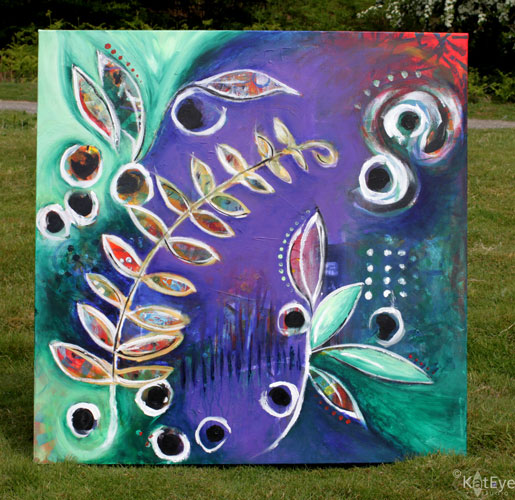
Leafing Out, 30x30in, Acrylic on Canvas

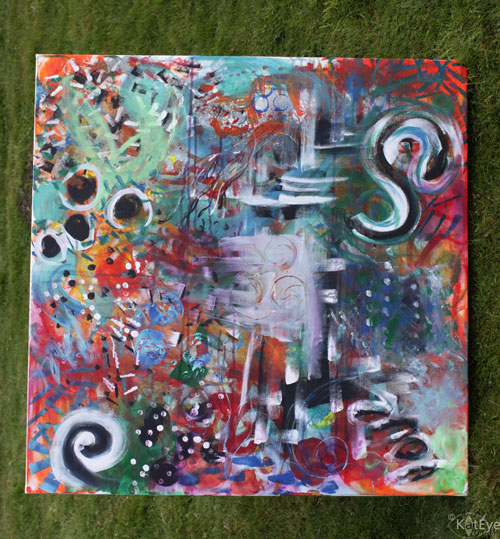
Painting #2: I wrote about the process to create this painting, start to finish, earlier this week. You can read that post here. I am more attached to this painting, because of the struggles I went through and what I learned on it, but I’m not sure I like it. I like the colors and the shapes, the brushstrokes, the individual elements. I struggled with the composition.

What I’ve realized is that composition in painting is very different than composition in photography. In my photography, composition comes naturally to me. My favorite type of photography is what I call “real life still life,” finding an existing scene and composing a photograph with the elements that are already there. Composition, in that case, is about eliminating what shouldn’t be in the frame so that my vision is clear. Painting is different. I’m creating the elements, adding them, subtracting them, combining them. There are just so many possibilities! I’ll have to work through this more, to find a compositional style in painting that comes intuitively.

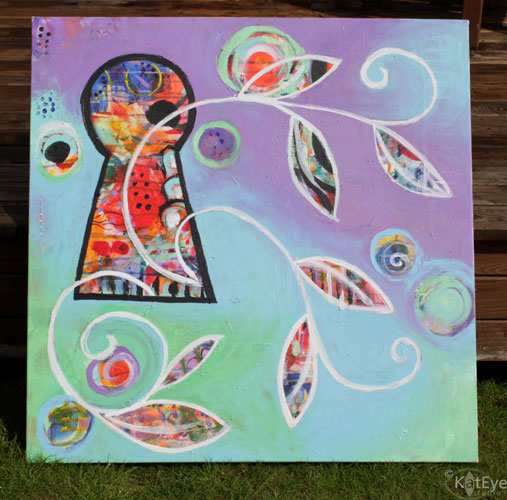
Unlocked (unfinished), 30x30in, Acrylic on Canvas

Painting #3: This is the canvas we started from scratch on the third (and last) day. Using all of what we had learned so far, it was time to integrate and work independently. Boy, was it fun!! This one came very easily so far, but it’s not complete. Others have commented, “It looks complete to me!” I know in my heart that it is not. I see a few things that I want to do, when I next get my hands on it. The visual elements represent how I feel about painting after this class too, as if there is something that has been unlocked inside of me. Something I’ve been trying to get at, but didn’t know how.

It was great to get the opportunity to do this third canvas, start to (almost) finish. Flora’s classes are usually two days and so this third canvas is not part of the normal plan. It really helped me to integrate what I’ve learned and see what would come out in a work that was on my own. I find it so interesting, how some of the elements are the same in all three – the circles, organic curving shapes of flowers, leaves and vines, the colors of the last two – mostly cool with some warm popping through. Here I’ve hardly painted and a bit of style is emerging. I love it! Right up my alley as I’m passionate about everyone finding their unique vision of the world, regardless of the art form.

There you have it! Three paintings – bigger, bolder and quicker than I’ve ever painted. I’m filled with so much joy and excitement about painting, a whole new world has opened up. I am completely and totally smitten. Now, these canvases have been removed from the wood frames and are rolled up, ready to be shipped to Oregon in July when I move back home from Italy.

After writing this, I’m itching to paint again and am resolving to make the time to get to it before we move. Happy Paint Party Friday everyone!

Filed Under: The Kat Eye View of the World Tagged With: do what you love, flora bowley, my painting, paint party friday

May 19, 2011 by Kat

Exploring with a Camera: Finding Form

Happy Exploring with a Camera Thursday! I’m so excited that for the next couple of weeks we will be Finding Form in our photographs. While I’ve been exploring form for a while, I didn’t become quite so focused on it until our recent trip to Greece. Today I will explain the idea of form and show you how I use it in my photographs. At the end of the post you will find the link tool to share your own photographs of form, or you can add them to the Exploring with a Camera Flickr pool.

What is Form?


It helps to explain form by contrasting it with shape. Shape is two dimensional, flat. Form is three dimensional, it has volume. In our photographs we can often find elements of both shape and form. In some cases, the object we are photographing really is flat, and has only shape. In most cases, however, the object we are photographing is really three dimensional, it has volume. We communicate those 3D forms in our 2D photographs through the angle and lighting we choose to capture.

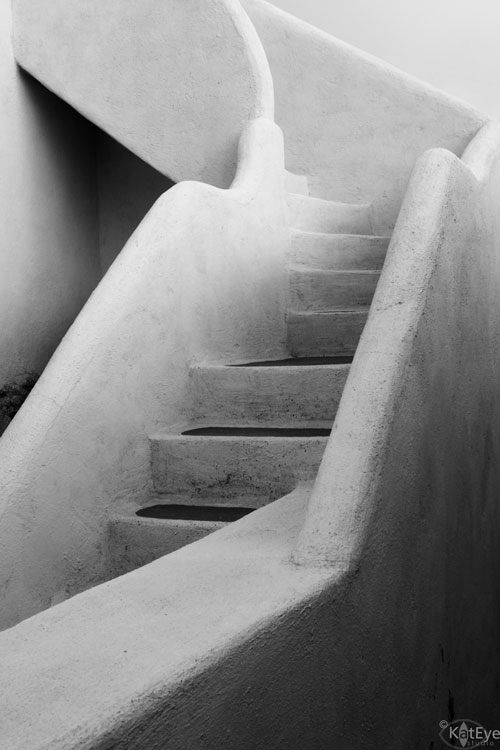
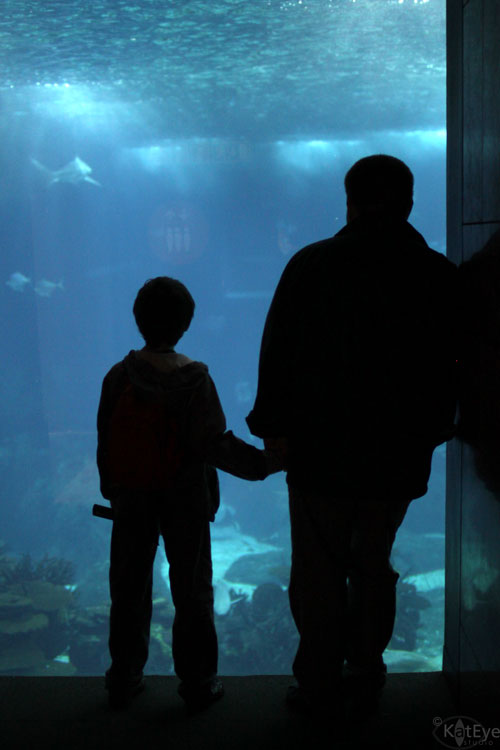
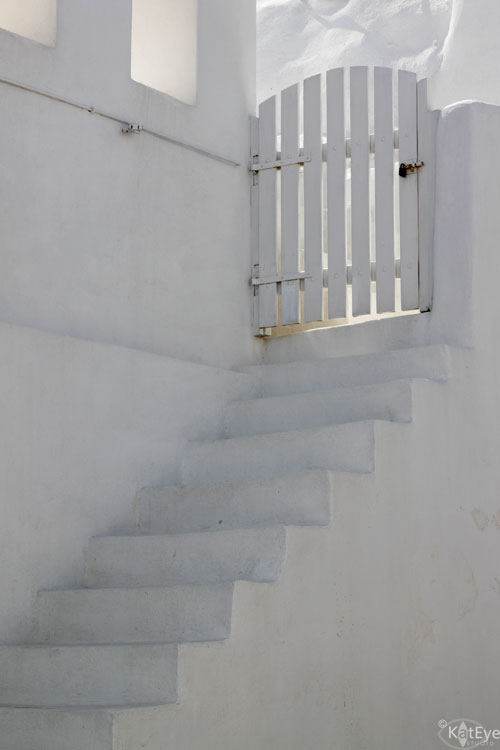
Before diving into examples of form, I’ll show you an example photograph of shape, absent of form. A silhouette is a shape, it has no volume. In the photo below, you can tell that these are people, but you don’t get much indication of the form by the silhouette, only the shape. Contrast that with the lead-in photo of the stairway on Santorini island, in Greece. In the stairway photo, there is dimension and movement. You move through the stairway and can see and feel its dimension – that’s form.


The light you use in your photographs is what expresses form. Do you need direct light or indirect light? What’s best? I found it interesting, as I consulted my photography reference books on this topic,  how discussion of form was either completely absent or contradictory. Only two books even mentioned shape and form as design elements in photography, and those two disagreed on what light best expresses form. 
So, in my explorations I looked at images where form was a dominant element and what type of light I was using, to share with you here. My conclusion: The light that best expresses form will depend both on what is available and on what you are trying to convey. Each type of light emphasizes different elements of form: Direct light seems to emphasize planes and edges while indrect light emphasizes curves.
Direct Light

Here is an example of direct afternoon sunlight, on the turret of this church on Santorini. The form is definitely expressed, you can see the dimension of the building through the different faces and the curve of the dome. The resulting form is very planar or angular, however, and the curves are minimized.

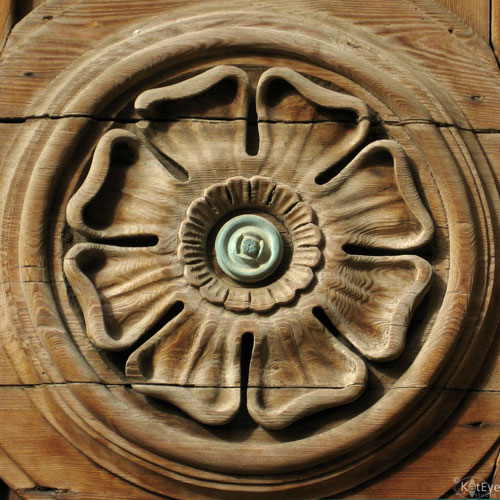
The volume of this carving, from a door found in Cefalu, Sicily, is clearly evident. There is a strong element of shape with the circles but the strong light and shadow gives the dimension of form. I almost want to reach out and touch it, run my fingers along the carved surfaces.

This image of footprints in the sand is all about form. There is really nothing “there” in this image. The photograph is of what is not there, the displaced sand, that the light and shadow highlight. Without the direct light, these footprints would not have the strong dimensional form you see here.

Indirect Light


Indirect light is softer, more gentle; It emphasizes the curves. I love indirect light for the gradations it provides, which serve to show volume. The indirect light on this Canova sculpture in the Louvre is marvelous for capturing the details of the form. Can you imagine this sculpture with a strong front or back light? The depth would be gone.


I have completely fallen in love with sculpture as an art, I think because it is pure form. Photography and sculpture have an amazing amount in common – both are about expressing light on a volume. The significant difference is that sculptors create the form from nothing while photographers capture the form that exists. Aren’t we lucky that those of us who aren’t going to carve marble have a way to communicate form?  I think so!

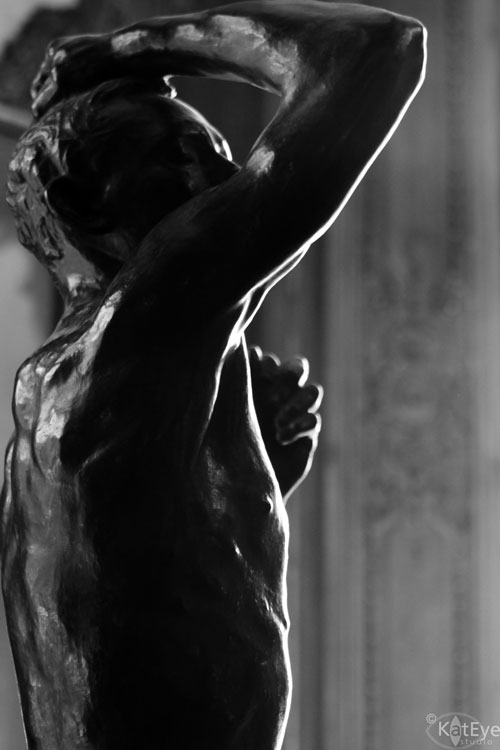
Here’s another example of form, expressed through light on a sculpture. You saw this image of a Rodin sculpture several weeks ago when we explored rim light, but the form is definitely captured by the indirect lighting from both sides.

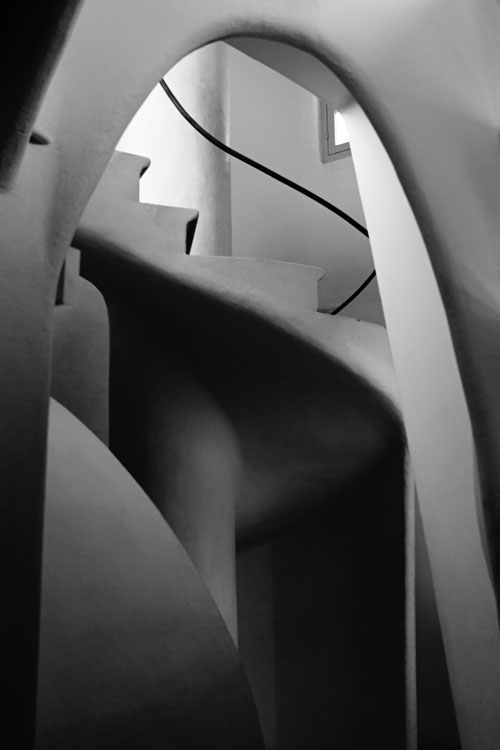
The attic of Gaudi’s Casa Battlo in Barcelona is a heavenly place to capture form in indirect light. This stairway has indirect light from several directions, which serves to highlight the various forms that it is made up of. The gradation of light and shadow give the image a lot of depth and layers to move through. The curves are emphasized.
Here is a final example of lighting from Santorini, a combination of both direct and indirect light in this scene. How do you think they work together? What does each type of light emphasize?
Color

In looking at my photographs that have form as a primary design element, I’ve noticed that they are almost always monochromatic. Removing variation in color helps to focus on the form. This can either be done by converting to black and white, or capturing a mainly monochromatic scene. This street corner in Brescia, Italy is a good example. The form of the buildings is emphasized through the light on the different surfaces. Since both buildings were pink, the image retains a feeling of form as one of the main elements.
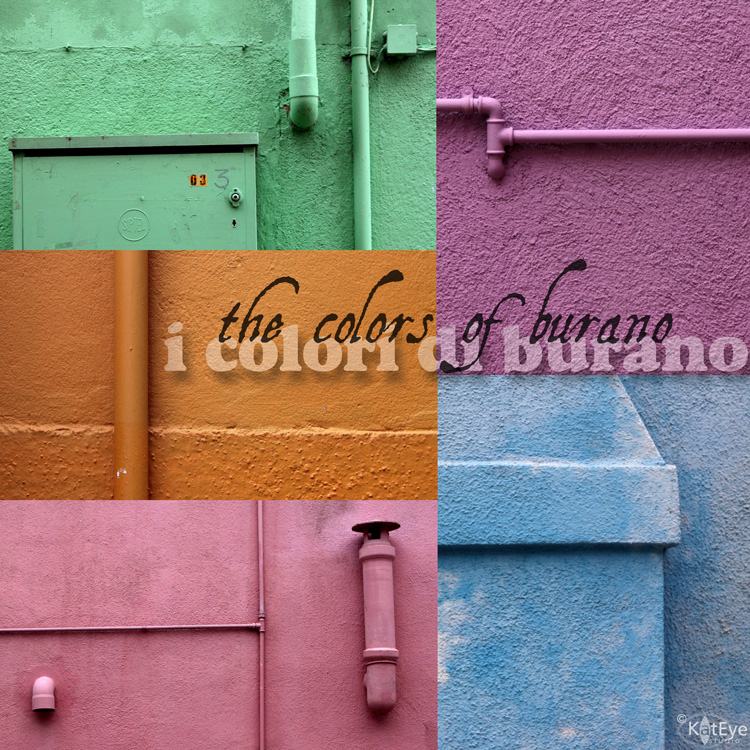
This group of images from Burano, Italy show variation in color when taken together. If you look at each one individually, you will see form as a dominant element in each photograph. These photos also serve as examples of how indirect light works differently than direct light to show form. The curves of the pipes and other elements are emphasized rather than the planes and edges. The indirect light gives a softness to the images, where direct light would give harder, distinct edges.
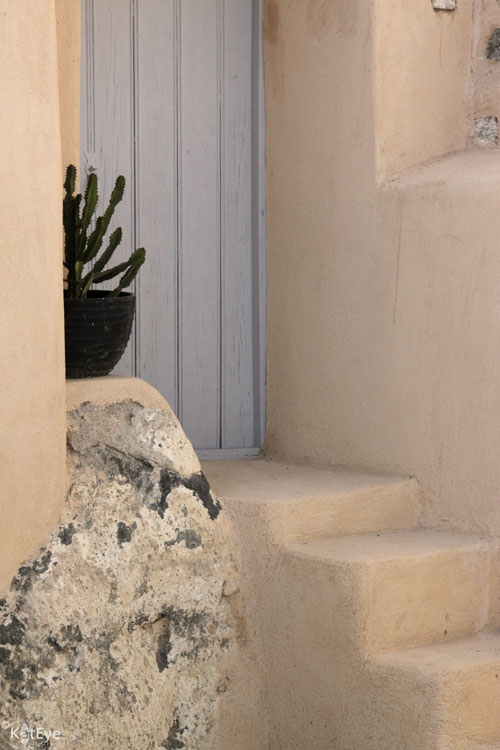
Images don’t have to be completely monochromatic to highlight form, as this photo from Santorini shows. The form of the wall and steps is a strong element in this photo because the colors are softer and don’t compete.

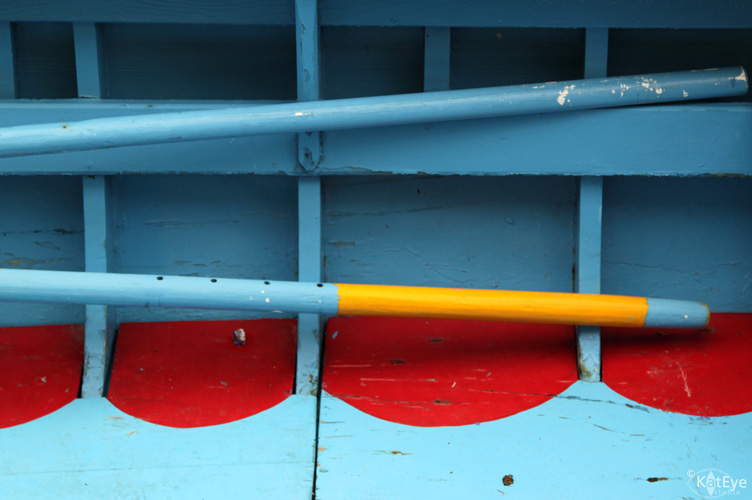
When there is strong color contrast, however, form can recede to a secondary element in the photograph. This image from Burano has a strong element of form, however the strongest design element of the image is color because of the contrast of the bright primary colors. Form takes a supporting role here.

I hope this has helped you to see what form is, and how you can use it in your photographs. Since photography is a two-dimensional expression of our three-dimensional world, finding and conveying form is a way to give our images depth. You may notice most photographs have an element of form in them, but it may not be the primary design element. 
Take some time over the next couple of weeks to find form. Natural or man-made, straight or curvy, every three-dimensional object has form. Go through your archives, or explore with your camera, and come back and share what you’ve found with everyone here. I say it every time, but I learn so much through the images you choose to share here! We grow our community knowledge that way. You can link your images in below or add them to the Flickr pool.  

Thanks so much for joining me here! Have fun exploring!


FYI – Links will be moderated. Please ensure that your linked image is on topic, and include a short explanation of how it relates to the current theme. Link back to this site through the Exploring with a Camera button (available here) or a text link. Thanks!

Filed Under: Exploring with a Camera, The Kat Eye View of the World Tagged With: architecture, dimension, finding form, Greece, Santorini, stairs

May 18, 2011 by Kat

Finding the Contrast

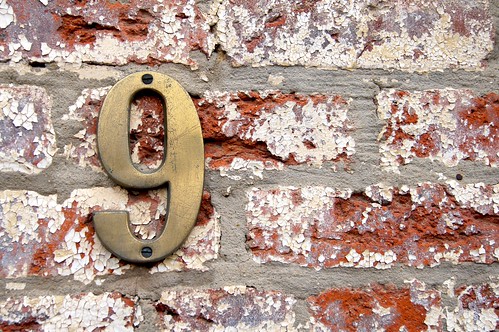
Number 9
Number 9 by tim mcmurdo

Sometimes, an Exploring with a Camera topic really strikes a chord with me and with all of you. Visual Contrast is definitely one of those times! It’s funny, I never quite know what is going to happen on a topic until I put it out into the world. I love how you all have run with this one, finding so many different kinds of contrasts in your images. I loved looking through the Flickr pool and I’m still visiting links, so I’ll be by shortly to say hi if you haven’t heard from me. 
Tomorrow we’ll move on to a new exploration, look at form in our photography. Not sure what I mean by that? Come back tomorrow and find out! You can also find me on Mortal Muses this morning, as we begin musing about shapes. I found the most amazing shapes created by light and liquid over the weekend that I’m sharing there today.
{218/365} Fading
{218/365} Fading by jennifée

Jennifée says: I find it interesting how nature contains all stages of life at the same time – both vibrantly alive and slowly dying, like here.

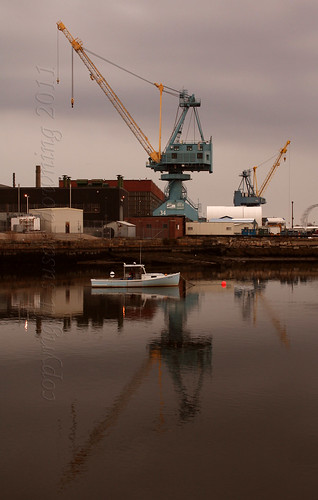
In the Crane's Shadow {235/365}
In the Crane’s Shadow {235/365} by Dorian Susan
Dorian Susan says: Lobster boat dwarfed by huge cranes at Portsmouth Naval Shipyard creates a contrast of big and small, industrial vs. simplicity of the common working man.

Filed Under: The Kat Eye View of the World Tagged With: share your view, visual contrast

May 17, 2011 by Kat

The Evolution of a Painting: A Thank You to Art

Yesterday I shared a tiny bit about the Do What You Love retreat, but honestly I was a bit at a loss for words. It was easier to let the photographs do the talking. How can you possibly explain the feeling of being in an environment where art and creativity, positive encouragement and infinite possibility are the norm for four days?

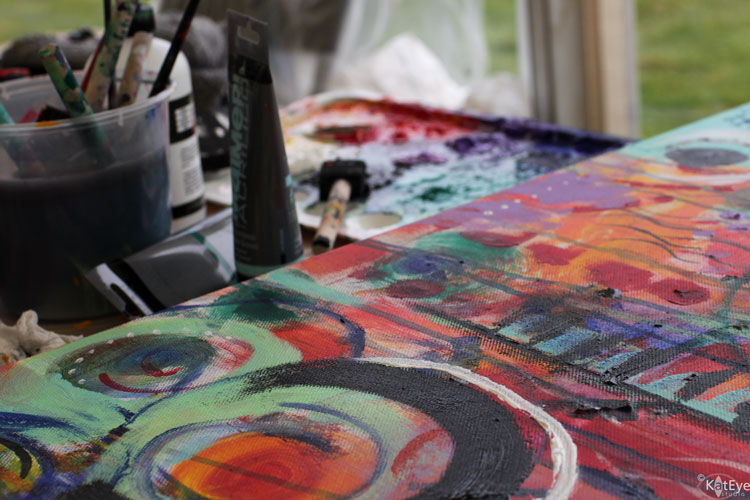
Today I thought I would share just a peek at some of what I experienced by showing the evolution of one of the paintings I created in Flora Bowley‘s class. Through showing you how it progressed through the three days and what I learned, I hope to give you an idea of what it was like. I created three paintings over the three days, and I’ll share the other two (one of which is pictured above, in progress) in Friday’s blog post. (I have to save something for Paint Party Friday, don’t I?)

The first day we quickly learned to get past the “blank canvas” syndrome. Flora’s painting technique starts with a lot of mark making. Using foam brushes, small paintbrushes, found objects, fingers, rags and a spray bottle we learned all sorts of ways to make marks on the canvas. We painted with our eyes closed, danced to the music, stopped for yoga stretches, just worked on releasing the tensions and expectations and using our whole body to paint.

One of the more interesting things we did early in the first day is paint on each other’s canvases. We rotated around the room, moving from canvas to canvas and Flora would tell us what kind of mark to make. We would practice that mark on the canvas we were at and then rotate to the next canvas to practice a new type of mark. The idea was to keep us from attaching too much to any one thing we painted. It definitely worked! It was very fun to see what our canvas looked like when we got back to it.

We spent the first day building up multiple layers of two of our 30×30″ canvases, painting in all of the colors of the rainbow. The idea was to give us lots of possibilities and directions the painting could go in terms of color, shape, subject. Here is the painting at the end of the first day:

Kind of wild, isn’t it? I definitely had lots of directions to go with this! I couldn’t really see how this was going to evolve into anything “beautiful” at this point. This was the canvas that everyone painted on, so it’s fun to know that the whole class had a part in creating this painting.

Here is the image again, rotated 90 degrees, in the orientation of the painting for later comparison. It’s interesting how you see different things when you rotate the painting, isn’t it? We did a lot of that, working from different directions.

We started the second day by writing a gratitude list and then sketching from nature. Flora encouraged us to look at both the broad vista and the close up for our sketches. We were in a beautiful place to do this! The Yorkshire countryside rolled along in front of us and the trees and flowers were in their spring bloom. She then showed us how she started to use what was working in the layers she had created, plus her sketches from the morning, to bring more out of the painting. She encouraged us to make a bold move, commit to something, not be afraid to cover up what was already there. You have to do this to make room for the new, great things that will come along.

That was probably the hardest lesson for me to learn in this class – covering up what was already there. I seemed to want to keep everything. I mean, what if it became important to the end work? It wasn’t until the end of this second day that I finally got this concept. It is only by truly committing and seriously covering up parts of the underpainting that the wonderful layers and textures begin to pop out. You need that contrast. (Interesting, isn’t it, that I’ve been exploring Visual Contrast in my photography.)

My “bold move” to start at the beginning of the second day was to paint the fern across the middle of the painting and then started to fill in around that. The other leaves and circles started to pop out and emerge, so I went with that. One of Flora’s mantras was to “go with what’s working.” Here is the painting at the end of the second day:

The color palette had emerged as mainly cool colors, green, blue and purple. I discovered I absolutely loved painting and mixing the dark and lights with my fingers, you can see that in the greens in the upper left corner. I really liked how the fern and the upper left corner were emerging, but was struggling with the bottom right. I hadn’t committed to anything there yet and had been reworking it. By the end of the day, I was just fried. I needed some time away from painting, so that I could get a better perspective and see what to do next. We had an evening off from the activities, so I drank wine and talked with my cabin-mates into the wee hours of the morning.
We started day three with writing an affirmation for the day. Taking a fear, or something we were struggling with, and turning it into a positive statement.  We taped this up on the wall of the painting tent, to remind us during the day if we got stuck. We also started with stretches, and had frequent breaks throughout the day for stretching, dancing, running around the field. Just keeping ourselves loose and having fun. Letting go. It was very funny, when Flora asked us as the beginning of the day if we wanted to start with a demo or if we wanted to just start painting, we enthusiastically answered that we wanted to paint!
When I stood back and looked at my painting in the morning of the third day, I had a very good idea what I wanted to do and just got on with it. I covered up some more of the bottom right area, bringing in the light greens from the upper left, and created some repetition with the black dots. 
I was struggling with the upper right area, the bright red. I liked the pops of red that were throughout the painting from the underpainting but that area wasn’t working for me. Flora suggested I pull the red through some other areas of the painting more, with little details. She didn’t tell me where or how to do it, just that it would help. What a great teacher! I’m sure she saw some things I could do but she didn’t tell me, she let me figure it out myself.
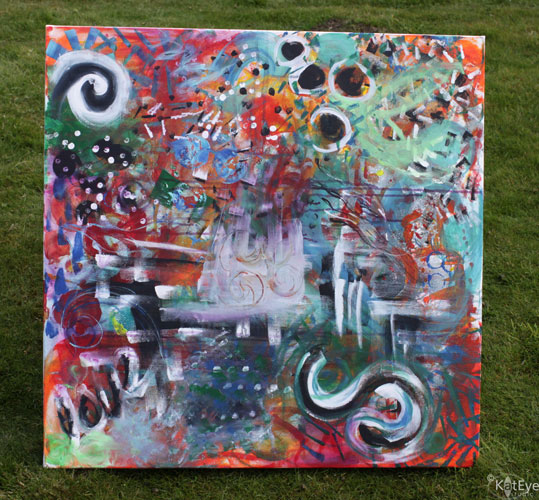
I finished the painting around the middle of the third day. Here is the finished work:

It is unlike anything I’ve ever done before. It is big, it is bold, it is unplanned. This isn’t necessarily my favorite of the three paintings, but this is definitely the one that I learned the most on. I struggled with things and broke through them. Flora’s experience, repeated many times to us, is that the paintings she struggles the most with are often her best work. She encouraged us to keep pushing through those barriers we found. To commit to bold moves. Look to nature for inspiration. Move our bodies. Go with what’s working. Reminding us that we made the marks that were there, we could always make them again.

It was a very emotional experience for many of us. It’s amazing how painting can be so connected to our core self, how much we can each individually struggle and the emotions it brings up. How we can attach ourselves to certain outcomes. How our inner voices can just destroy our confidence. There are so many parallels between painting, or any art, with our life. I learn this over and over again as I continue explore art and creativity. I have learned more about myself through art in the last couple of years than through anything else, ever.

Thank you to Flora, for being such a wonderful teacher. She gave us the tools and lessons but let us find the ways to make our painting an expression of our self. Thank you to my classmates, who provided all sorts of positive encouragement and support for each other along this journey, which was difficult at times. Thank you to Beth, for creating such a wonderful environment at the retreat that we could learn these amazing things about art and life. And thank you to art and creativity, for being the thing that makes me whole.

(Stephey Baker of Marked by the Muse is doing a “Thank You to Art” link up right now. What perfect timing! Visit her site to see more stories and link your “thank you” in.)

Filed Under: The Kat Eye View of the World Tagged With: do what you love, my painting, painting, retreat

« Previous Page
Next Page »

search

Archives

© Copyright 2017 Kat Eye Studio LLC